|
The Frontier Culture
Museum: Outdoor Living History in Virginia
Story and Photographs by
Tom Straka
History buffs will love an interstate stop
that chronicles Virginia's (and America's) cultural history.
It's located about a mile from the intersection of Interstates
64 and 81 in Staunton, Virginia. The
Frontier Culture
Museum touts itself as the biggest open-air living history
museum in the Shenandoah Valley, as well as one of the highest
rated family-friendly attractions and one of the top tourist
destinations in Virginia. Costumed historical interpreters show
the life and customs of the indigenous Native American tribes in
Virginia, the arrival of the German, English and Irish settlers
along the Great Wagon Road, and the painful journey of the
enslaved Africans to the first permanent British colony in North
America. Visitors may also interact with a blacksmith at an
Irish Forge, woodworkers, tailors, and yarn spinners, and learn
how the early settlers of America cooked and worked the land.
The museum is about
cultural origins. Its purpose is to tell the story of the
thousands of people who migrated to colonial America, and of the
life they created here for themselves and their descendants.
These first pioneers came to America during the 1600s and 1700s
from communities in the hinterlands of England, Germany,
Ireland, and West Africa. Many were farmers and rural craftsmen
set in motion by changing conditions in their homelands and
drawn to the American colonies by opportunities for a better
life. Others came as unwilling captives to work on farms and
plantations. Regardless of how they arrived, all became
Americans, and all contributed to the success of the colonies,
and of the United States.
A trail leads the visitor through two
sections: Old
World and American exhibits. In the Old World exhibits, you
can experience daily life in farm households in the 1600s and
1700s in England, Ireland, Germany, and West Africa. The
emphasis is on the culture from the Old World that was the basis
of developing an American culture. It shows people living by
farming, local trade, and skills such as spinning and weaving,
blacksmithing, or wood-working. Their labor and available
resources were dedicated to providing the needs of the household
and meeting the obligations imposed upon them by their
community, landlord, or ruler. An extraordinary turn of events
brought people born England, Ireland, Germany, and West Africa
together on the frontier, where American Indians had lived for
centuries. Over time, all of these different groups created
American frontier culture, a distinct culture which to this day
shapes American identity.
The American exhibits take the visitor
through Virginia and American history and culture from Native
Americans to the Valley of Virginia in 1760s, 1820s, 1840s,
1850s, and 1860s. Exhibits also include an 1840 schoolhouse, an
1860 African-American church, and octagonal barn. One of the
most interesting aspects of the American exhibits are costumed
historical interpreters, especially those showing the crafts and
trades. I especially enjoyed peppering the Irish blacksmith with
technical questions, as he was using an active forge. The
American section is frontier culture from beginning to end.
Old World Exhibits
The trail begins with an
eighteenth century West African farm reproduction from
Igboland, a region located in modern-day Nigeria. West African
peoples were linked by an extensive trade network which covered
large areas of the continent. West African societies were
structured around trade and manufacturing, agricultural
production, family kinship and ancestor worship. The arrival of
Europeans on Africa's Atlantic coast in the 1400s brought great
change to them and their neighbors. Due to the slave trade, over
the course of five centuries, more than ten million Africans
were taken from their homelands and forced to another continent.
Approximately 30,000 Igbo were shipped to
Virginia between 1716 and 1755. Race-based slavery soon became a
central feature of life in Virginia. Unfree, African labor
contributed to the growth and success of the local economy and
the wealth and status of enslavers. As settlement expanded
westward, enslaved Africans and African Americans in the
backcountry participated in the cultural exchange on the
frontier. Contributions to American culture are found in
foodways, music, folklore, and religious worship. When
permitted, Africans influenced the form and function of the
pottery, basketry, wood-work and textiles they produced for
others.
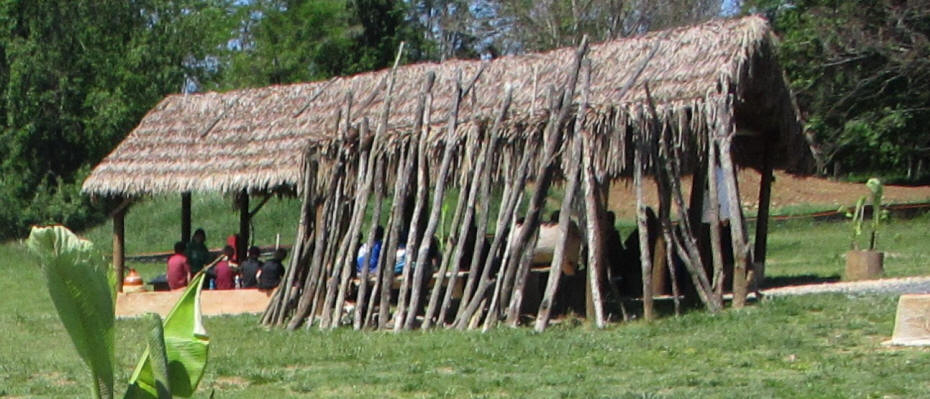
A group learning about
West African culture in a covered West African pavilion.
The second Old World stop is
1650s England. The period between 1500 and 1700 was a time
of great social change in England. Much of the rural population
was uprooted as a result of enclosure (or fencing), which accelerated during
the 1600s. English colonists started to permanently settle in
North America in Jamestown in 1607. Over the next century they
established other English colonies along the Atlantic coast. By
1700, almost 250,000 people lived in the colonies. Most of them
had English roots.
European settlement slowly crept westward
into the piedmont, and by the mid-1700s Anglo-Virginians crossed
the Blue Ridge Mountains and began to settle in the Valley of
Virginia. English culture and traditions were dominant in
England's North American colonies due to the numbers of English
settlers, and the role the Crown and English proprietors played
in establishing those colonies. Based on the English model, in
Virginia this culture quickly took the form of a patriarchal and
hierarchical society led by the "gentlemen" of the colony.
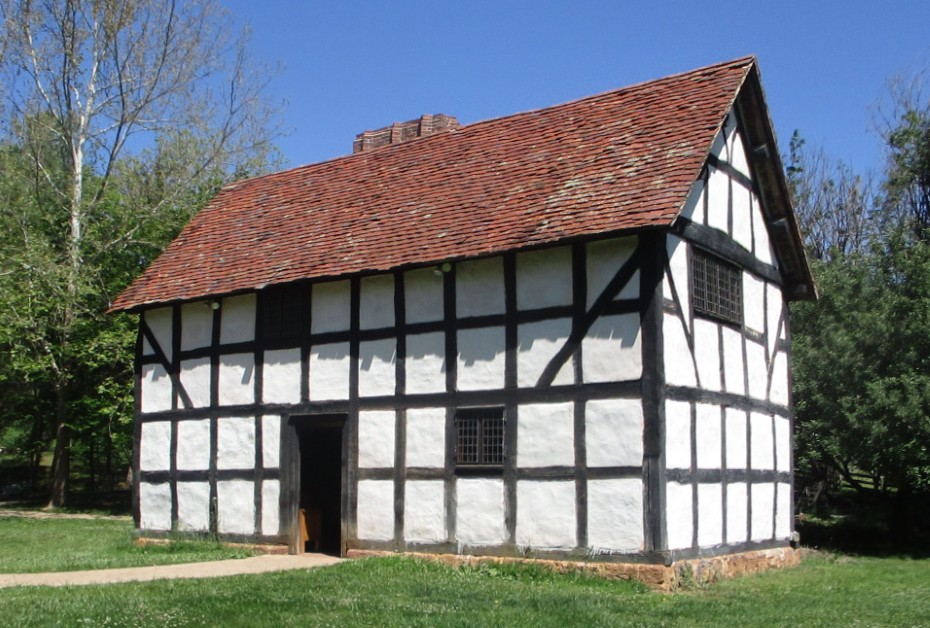
The
timber-frame farmhouse on the English exhibit was originally
built by an independent farmer in Worcestershire, England, in
the 17th century.
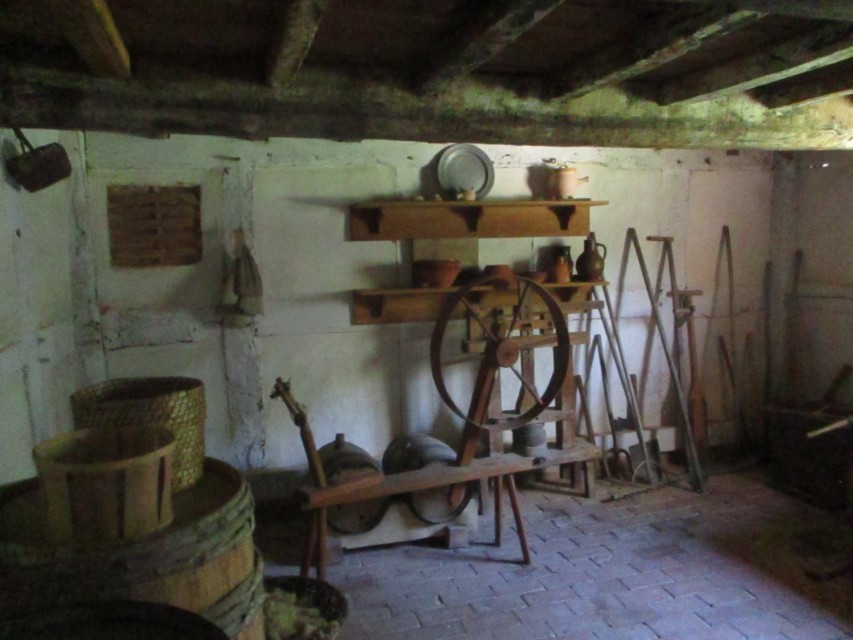
The
inside of the English house contains all kinds of everyday
items.
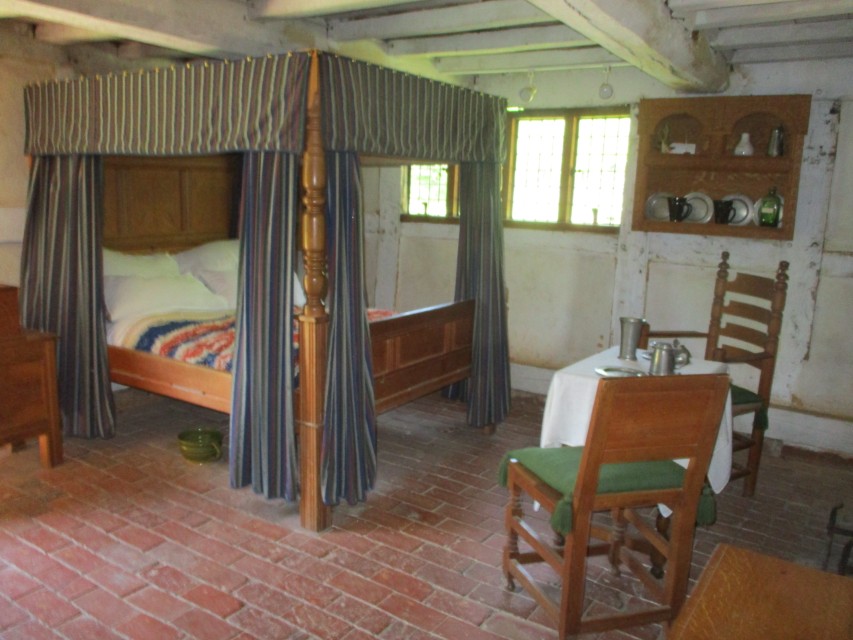
A 17th
century English bedroom.
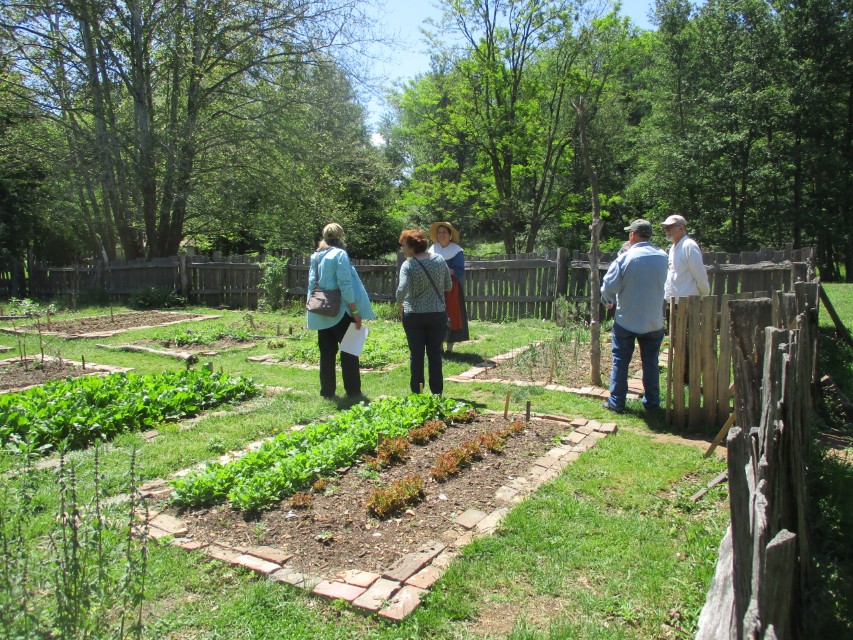
Near
the English house was an interesting English garden.
The third stop is a late-18th century
Irish Forge and blacksmith shop that stood in County
Fermanagh in the Irish province of Ulster, in what is now
Northern Ireland. Like their farming customers in Ulster,
blacksmiths and their skills immigrated to colonial America
along with other Scots-Irish. Immigrants with special craft or
trade skills were recruited by colonial merchants and
governments in the early years of colonization and
intermittently when the colonies needed specialized labor. These
artisans provided labor, services, and goods to ensure the
success of the colonies. Blacksmiths in particular possessed
skills which were needed to produce and repair tools for the
cultivation of land and the building of houses and
infrastructure.
The 18th-century blacksmith in Ireland was
a businessman. Although the smith might be engaged in farming,
their primary function in the local economy was blacksmithing.
They provided important services to their community. The smiths'
primary job was to repair broken items. In rural villages they
also made new items when needed since access to merchandise was
often limited.
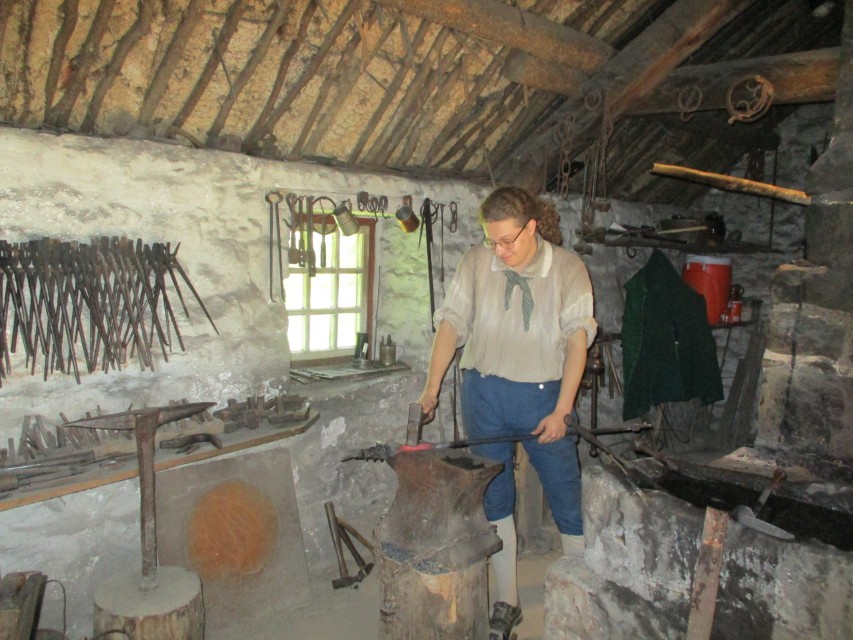
The Irish forge was operating with red
hot coals and a blacksmith that knew all the details of forging
iron.
The fourth stop was an
1750s Irish farm.
Irish Protestants from Ulster,
often called Scots-Irish, started to move to the American
colonies in 1718. Most Ulster immigrants came to the colony of
Pennsylvania. Competing with the Germans for land in
southeastern Pennsylvania, many Irish families made their way
through the Great Valley of the Appalachians to settle in
western Pennsylvania, Maryland, Virginia, and the piedmont of
North Carolina. By the end of the 1700s, their culture was the
dominant English-speaking culture in the colonial American
backcountry.
At the time of the American
Revolution, more than 100,000 Ulster immigrants had arrived in
America, representing the single largest movement from the
British Isles to British North America in the 1700s. Scots-Irish
were often found in newly opened areas on the western edge of
settlement where they served as a buffer between Native
Americans and older, established eastern settlements. Due to
their numbers, they emerged as the dominant cultural group in
the backcountry and they shaped frontier culture in many
different ways such as in architecture, language, music,
education, religion, and in libation through the introduction of
whiskey.
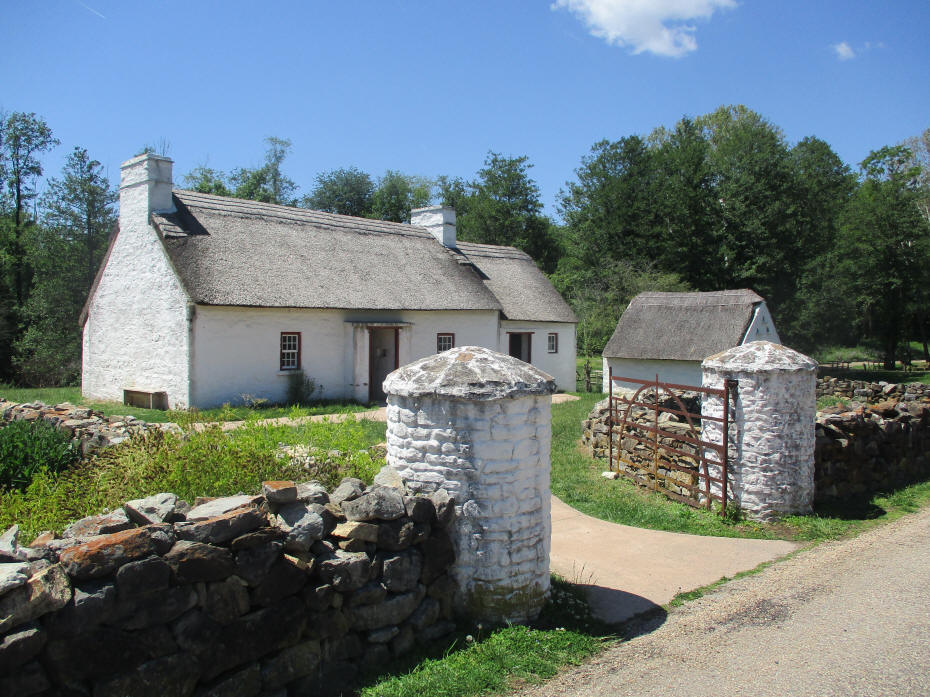
The Irish Farm at the
Museum originally stood in County Tyrone in modern-day Northern
Ireland.
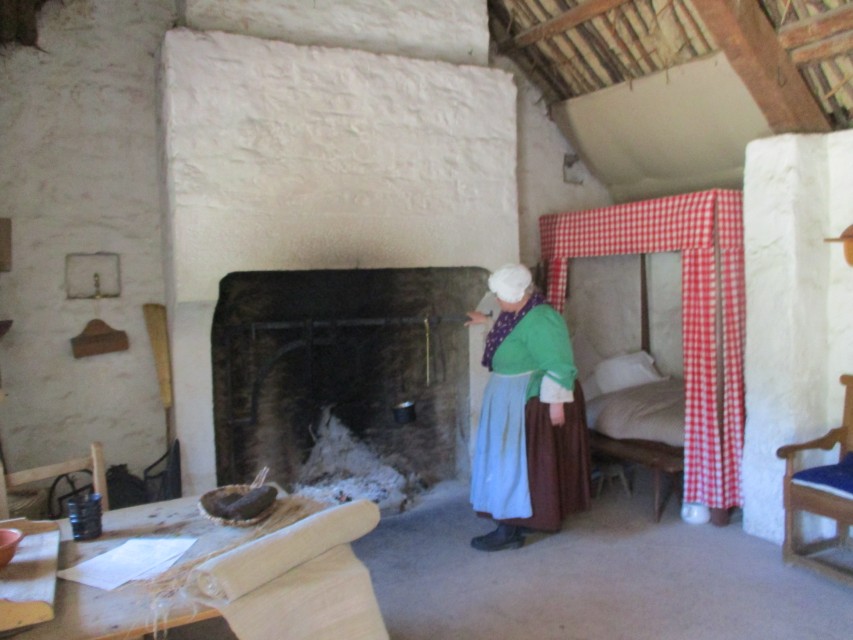
Inside the Irish house,
with a talkative inhabitant.
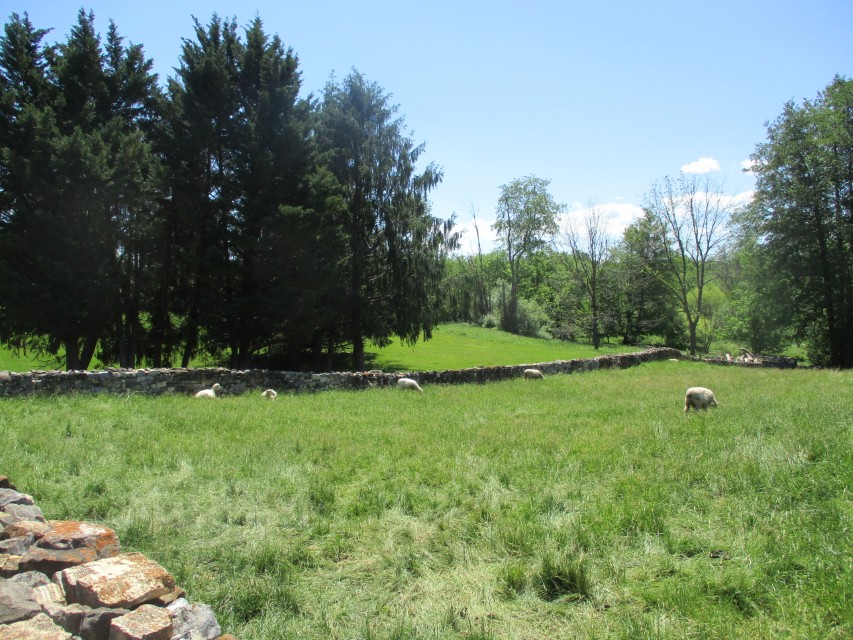
Adjacent to the Irish house were sheep
grazing. There are plenty of agricultural animals in the
exhibits.
The last stop in the Old World
is a
1750s German farm.
Traditional peasant farming became increasingly difficult during
the 1700s in Germany. Population growth, and the practice of
dividing farmland among all family heirs resulted in smaller
farms and forced many families to practice a part-time craft to
survive. Textile trade, blacksmithing, and woodworking were
common crafts practiced in peasant households. By 1775, roughly
100,000 German-speaking immigrants, mostly tenant farmers and
rural artisans, had arrived in the colonies in the 18th century.
Germans were the largest group of non-English speaking Europeans
to settle in colonial America.
The chief port of entry for
German immigrants was Philadelphia, from where they spread into
the countryside in search of land. Many of the early arrivals
settled in southeastern Pennsylvania near Philadelphia. Others
pressed further west to settle near the Susquehanna River or
south to the colony of Maryland. Over time, German-speaking
colonists found their way into the Great Valley of the
Appalachians and pushed into western Maryland and, by the 1730s,
across the Potomac River into the northern Valley of Virginia.
In the decades that followed German settlers and their
American-born descendants continued moving south and west,
leaving a distinctive mark on American culture wherever they
settled.
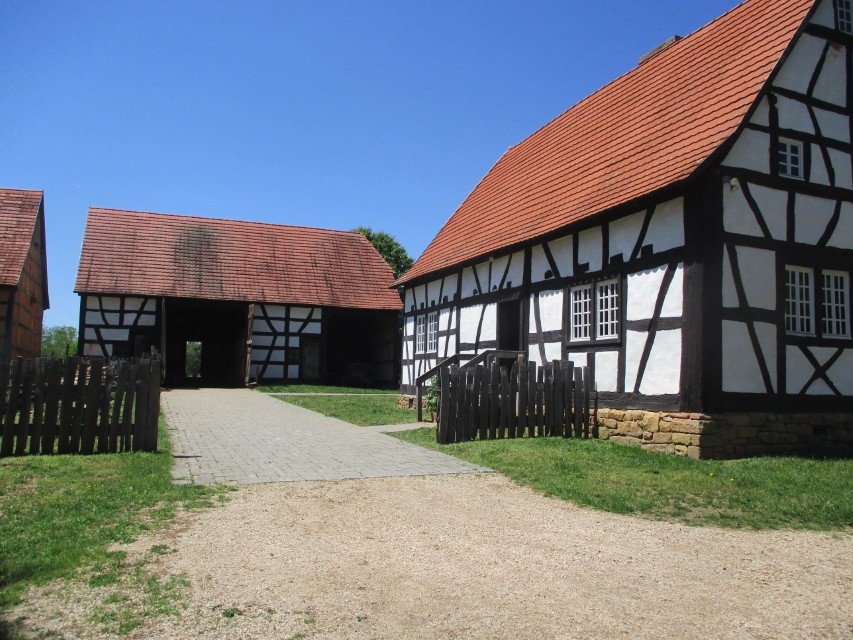
The German Farm was originally located in
the Rhineland Palatinate in modern-day Germany. The
timber-framed style is typical for 18th-century farming villages
in southwestern Germany.
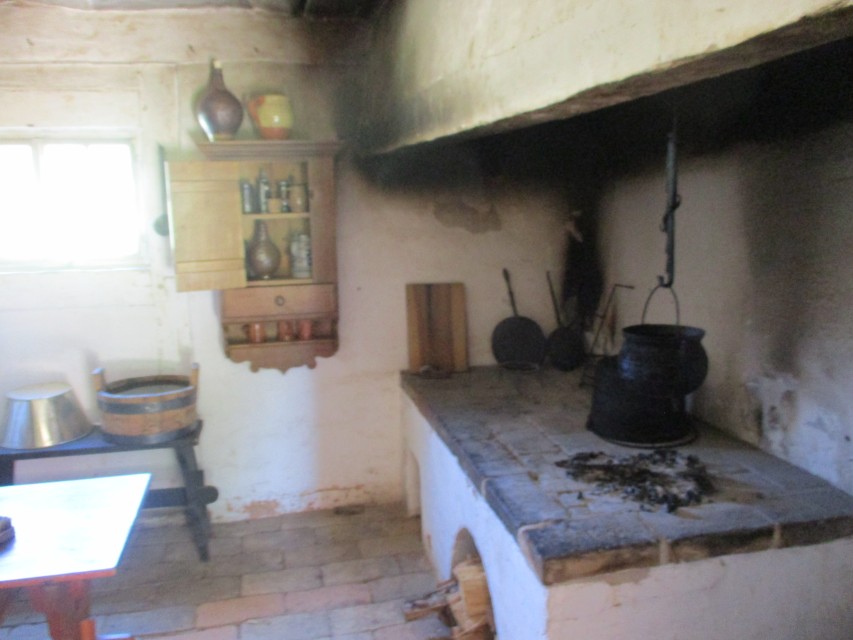
Inside the German house.
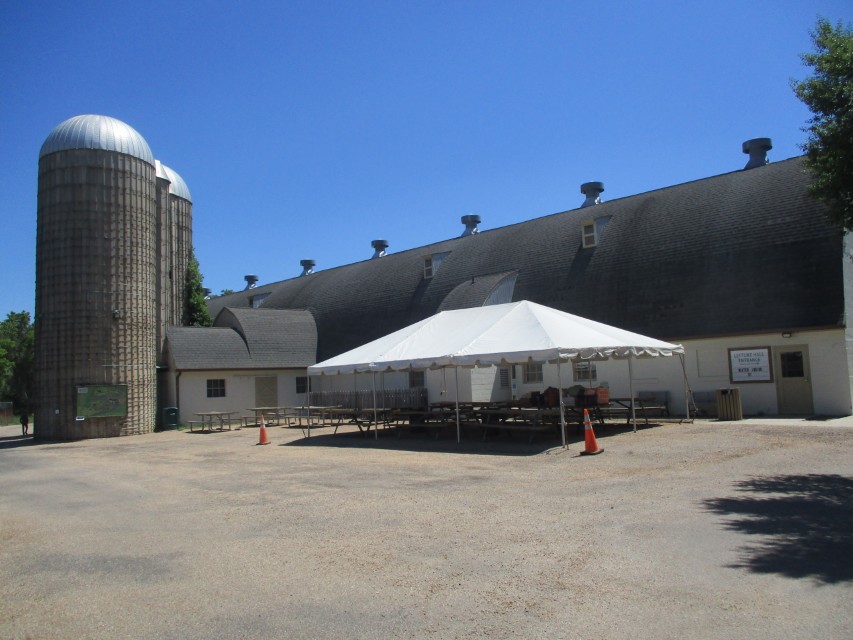
An interesting lecture
hall complex separates the Old World and American sections.
New World
The Old World influences met on
the Virginia frontier-- English, Scots-Irish, German, Native
American, African, and other groups. They were brought here by
global forces beyond their control. The struggles, cooperation,
and conflicts they experienced created a unique frontier
culture. The frontier experience is a vital element of the
broader American experience which shaped a distinct American
identity. Elements of these cultures remain clearly visible
among the foundations of the American identity today. They are
apparent in the New World exhibits.
The New World section begins
with the
Native American exhibit.
This exhibit at the Museum represents a small Eastern Woodlands
Indian community in the Great Appalachian Valley in the early
1700s. The Eastern Woodlands cultural region covered a vast area
from the Atlantic to the Mississippi river, and from the Great
Lakes to the Gulf of Mexico. The diverse American Indian groups
in this region shared some cultural characteristics, but were
distinctive in housing, foodways, language, and social
structures.
American Indians played a
crucial part in the development of frontier culture. Some
European settlers were ill equipped to survive in North America,
but access to American Indian knowledge and practices aided them
in establishing and expanding England's North American
colonies--often to the detriment of American Indians and their
cultures.
The rapid decline of American
Indian groups and communities from eastern North America in the
1700s did not diminish their deep and enduring influence on the
American frontier culture that formed there. European immigrants
and the American-born men, women, and children, who settled the
colonial frontier, encountered Native peoples, and adopted some
of their ways to succeed in frontier conditions. This was a
major contribution to the emergence of American frontier
culture.
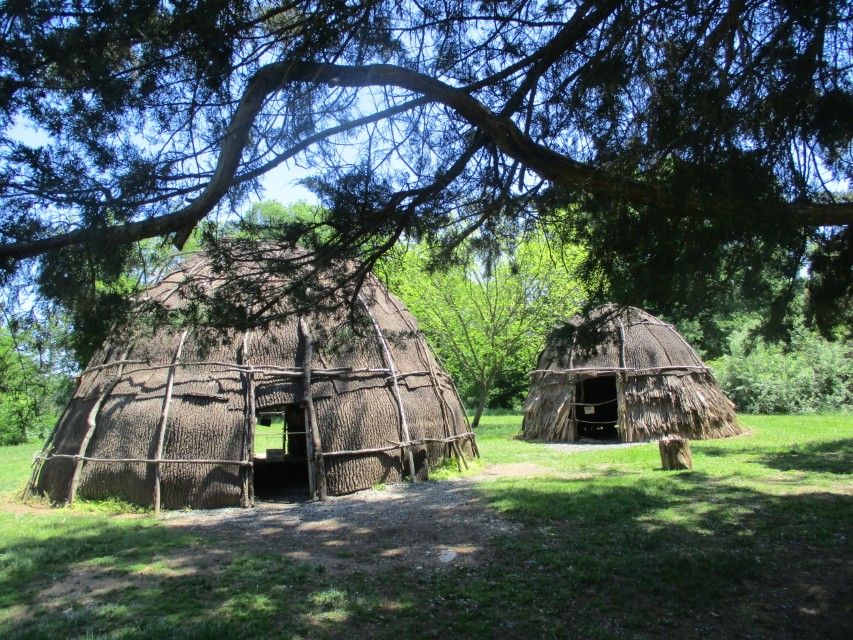
The edge of a Native
American community.
The second
American stop was the
Valley of Virginia in the 1760s.
Settlement of America's Appalachian river valleys began in the
late 1720s, and the early settlers typically built one-room log
cabins like the reconstructed building at the Museum. The
earliest settlers in Virginia's backcountry were German and
Scots-Irish farmers from Pennsylvania. The colony of Virginia
enacted generous land policies to attract settlers to its
frontier areas. The colonial government intentionally used these
settlers to create a buffer zone between American Indians and
French in the interior and the developed areas in eastern
Virginia. These early settlers on the frontier were soon joined
by Anglo-Virginian settlers and African and African-American
slaves from eastern Virginia. Settlers were motivated by a
common desire to obtain a freehold farm capable of supporting
their families and providing extra land to sell or pass on to
the next generation.
The earliest
settlers arrived on foot, leading packhorses carrying a few
tools and possessions over paths established by Native
Americans. Later settlers traveled by wagon over the same routes
after they were widened and improved.
Most settlers intended to farm, and
they sought land that featured a reliable water supply and a mix
of forest and open ground. Native Americans intermittently had
lived on the land before the arrival of Atlantic settlers, and
they had established home sites and fields on the best available
locations. Shrewd early settlers selected these sites, leaving
poorer land for those who followed. After selecting a parcel of
land and securing legal title, the settlers built a shelter and
cleared land for crops. Their first house was often a one or two
room log cabin, built by family members with the assistance of
neighbors, and possibly an indentured servant or slave.
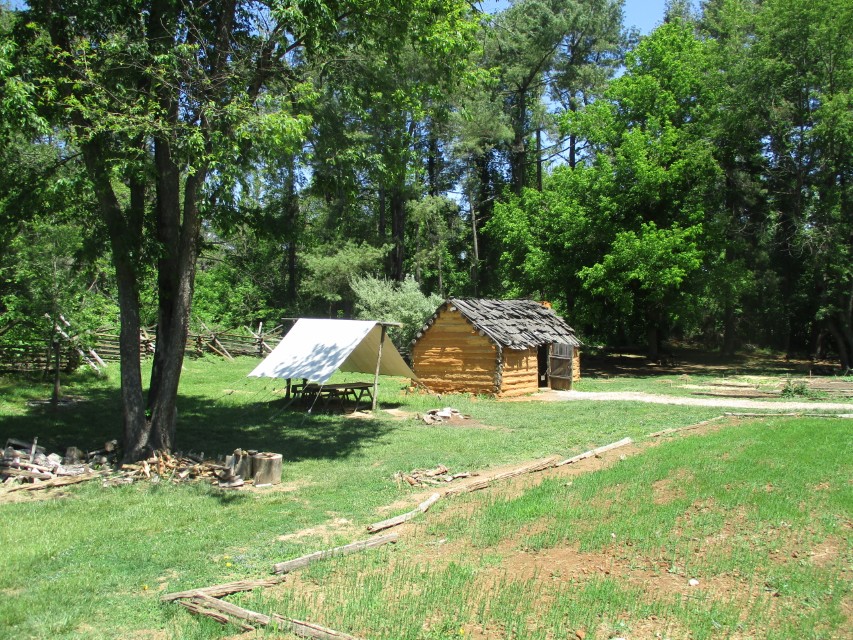
Reconstructed 1760s
one-room log cabin homestead.
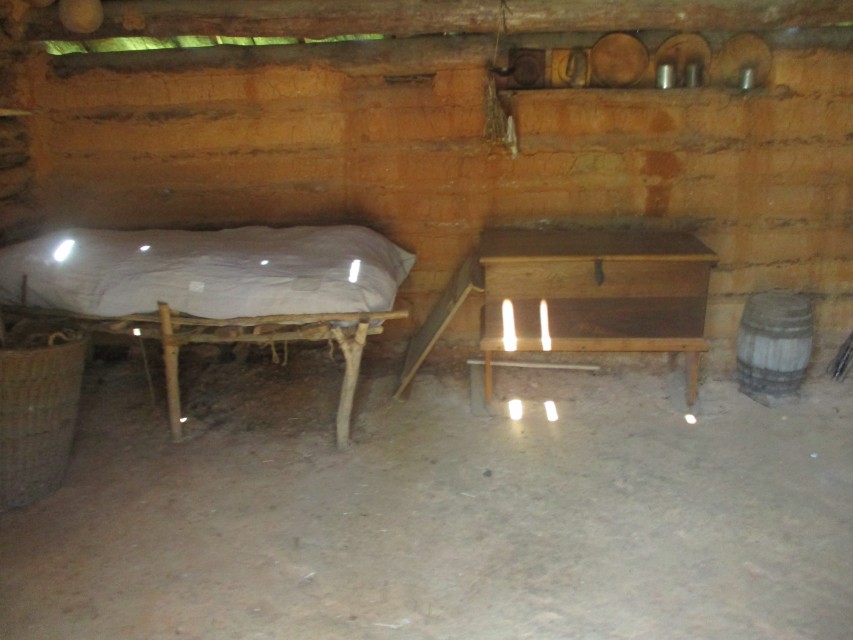
Inside the 1760s log
cabin.
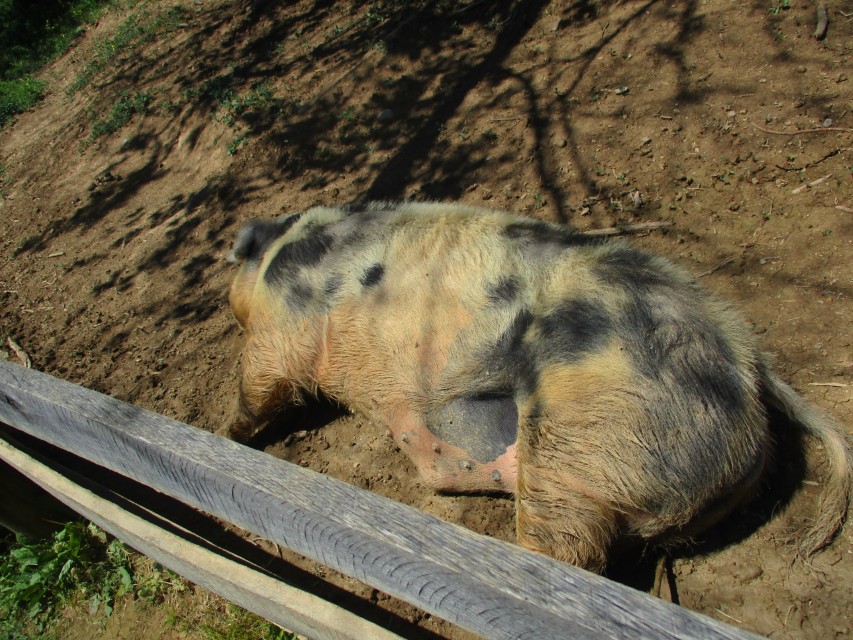
No, this is not a dead
pig. This is a porcine reenactor on a hot day taking a nap. It
attracted a lot of attention from the kids.
The third stop was the
Valley of Virginia in the 1820s.
The 1820s American Farm was originally built by a German
immigrant farmer in 1773 in Rockingham County, Virginia.
Anglo-American influences entered the Virginia German lives
slowly. By the 1820s, English furniture forms, such as the chest
of drawers, began to appear in their houses. They became tea and
coffee drinkers and began using imported English dinner plates
and teacups. This exhibit shows how the various cultures merge
over the 50 years which span the periods of the American
Revolution and the Early Republic. By the 1820s, the different
peoples who settled the Valley of Virginia had lived together
for several generations. They were shaped by the common
experiences of settling on the frontier, the American
Revolution, the founding of the United States, and the market
revolution. As a result of these shared experiences, ethnic
differences began to fade.
Farmers in the Valley of
Virginia were engaged in mixed farming dominated by grains and
livestock. The main cash crop was wheat, which was ground into
flour at local mills for export to eastern markets. Other crops
included corn, rye, barley, and oats, which were used as animal
feed or distilled into liquor. Livestock included horses, which
were used as draft animals, cattle, swine, and sheep. Cattle and
swine were particularly important. Cattle were driven to eastern
cities for sale, while hogs were raised primarily for home
consumption.
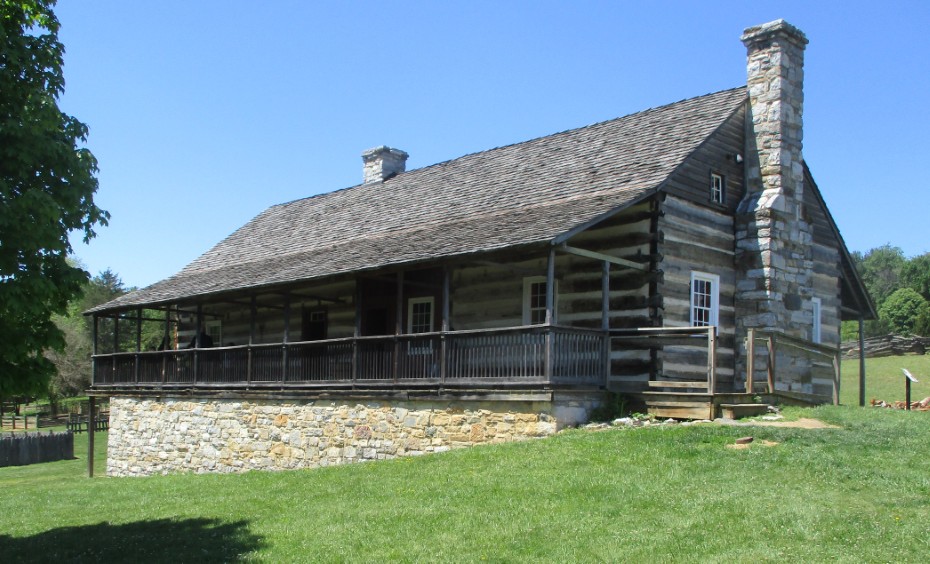
The quality of the
homes increased between 1760 and 1820.
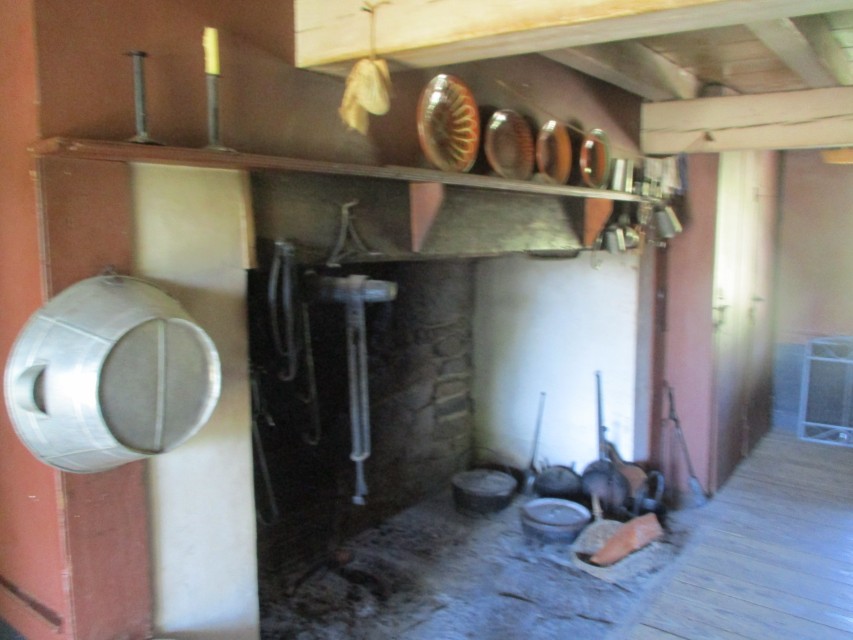
Inside of the 1820s
house.
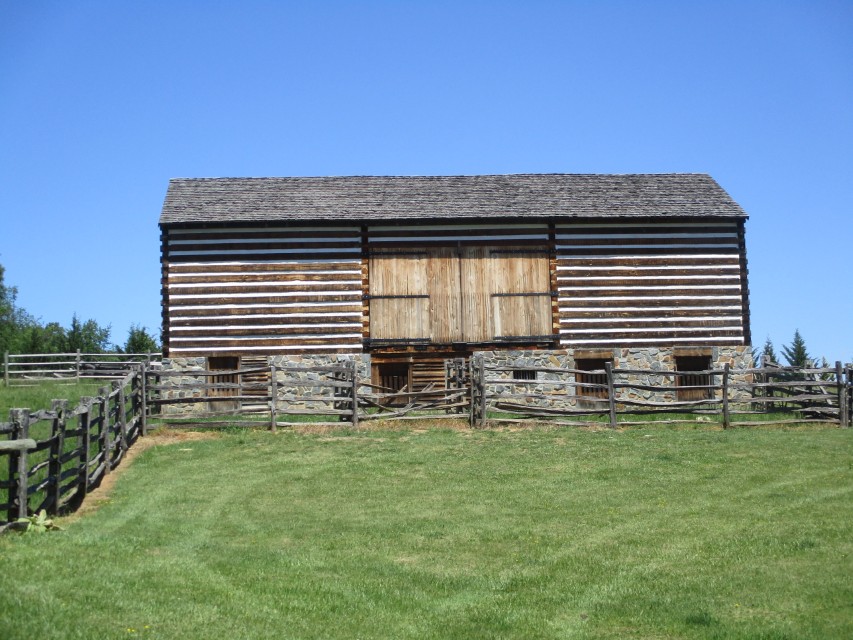
This reconstructed barn
is modeled on a three-bay bank barn in Winchester, Virginia. It
is considered to be a variant of the Pennsylvania barn.
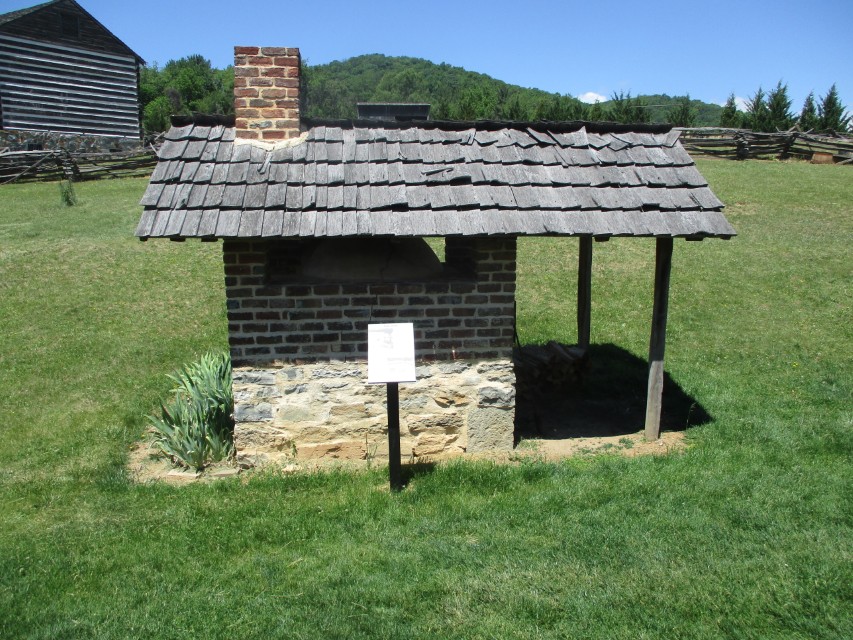
There are many smaller
structures scattered about, like this bake oven.
The 1850s close out the trail's
timeline with the
Valley of Virginia in the 1850s.
The 1850s American Farm was originally located in Botetourt
County, Virginia. A farm like this would have been owned by a
family of "plain folk." The farmhouse is modest. New forms of
technology and methods of construction were being used to build
it and the other buildings. Different floor plans and
architectural styles reflect different cultural influences.
By the 1840s, Euro-American
settlers were venturing ever-deeper into the trans-Mississippi
West. The settlement of Texas began as early as 1822, when it
was still a Mexican province, and many of the early founders and
leaders of Texas were Virginians. After Texas, the next
important destinations were Oregon and California, particularly
after gold was discovered in California in 1849.
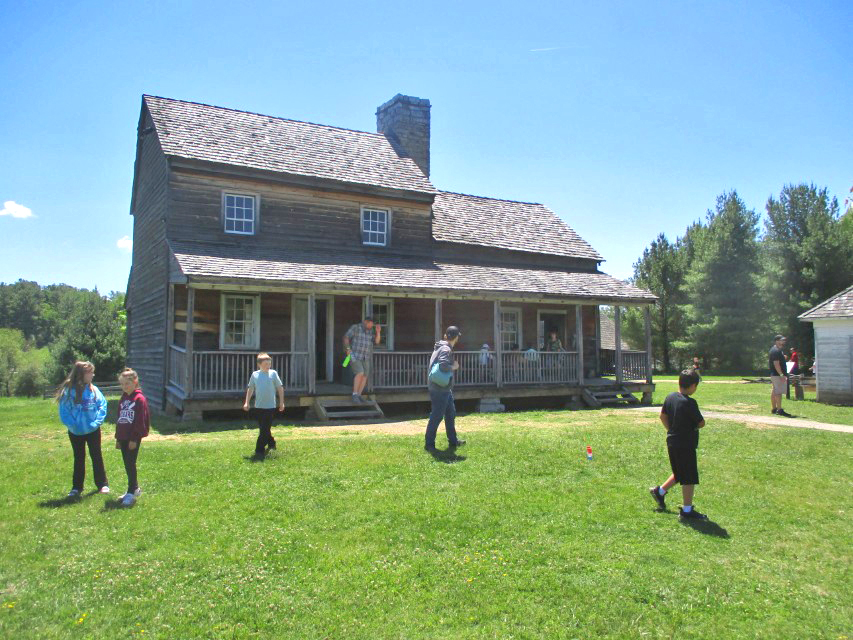
The quality of the
houses increased by 1850.
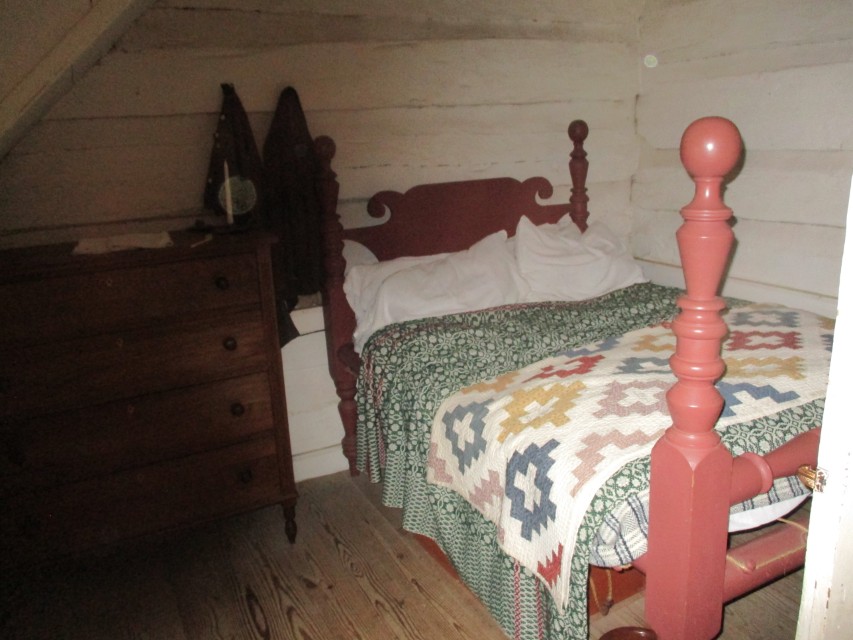
Inside the 1850s house.
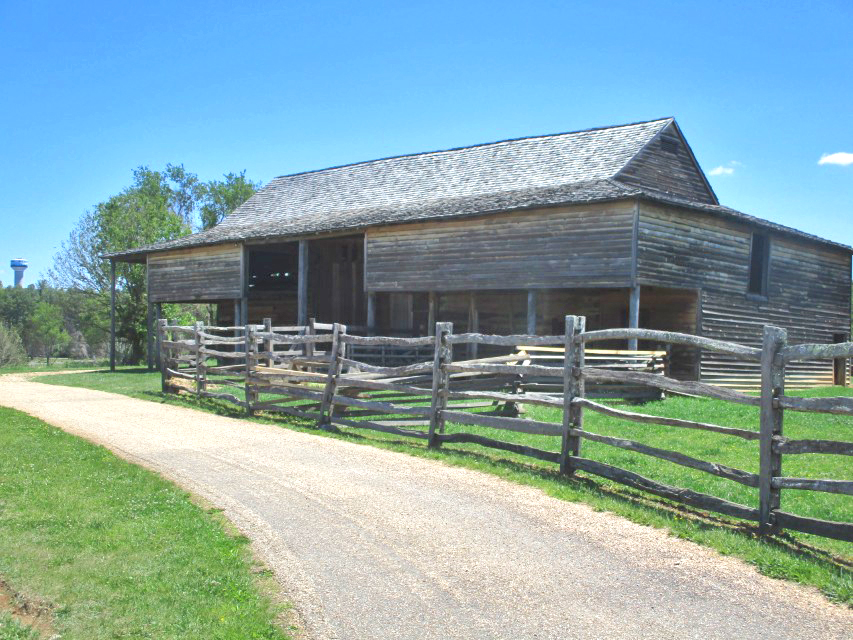
This ground barn
(ground-level access) was common in Botetourt County, Virginia.
Before finding its way to Virginia, this style was likely
introduced to Pennsylvania in the 18th century by
German immigrants. The large barn was built with oak and yellow
pine timber.
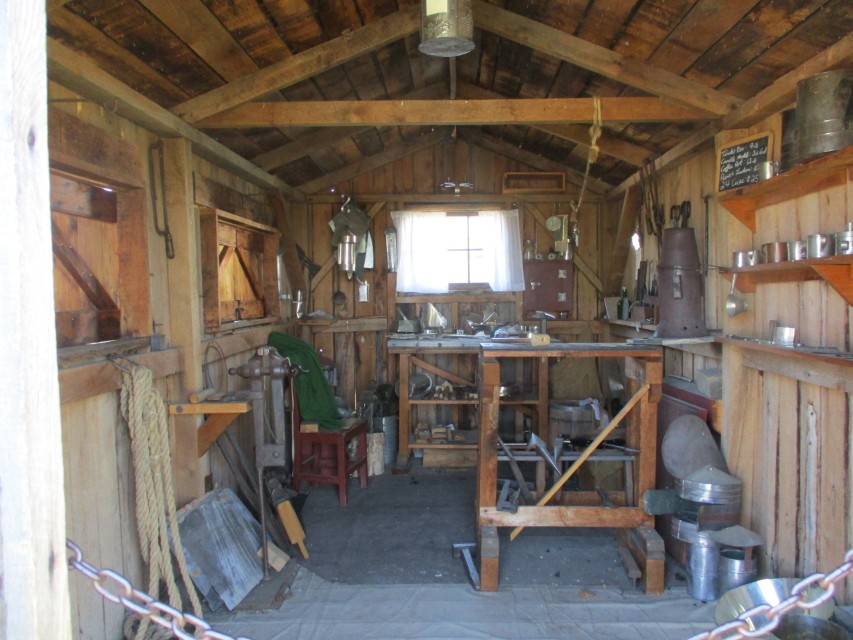
The inside of the
tinsmith's cabin showed some interesting tools.
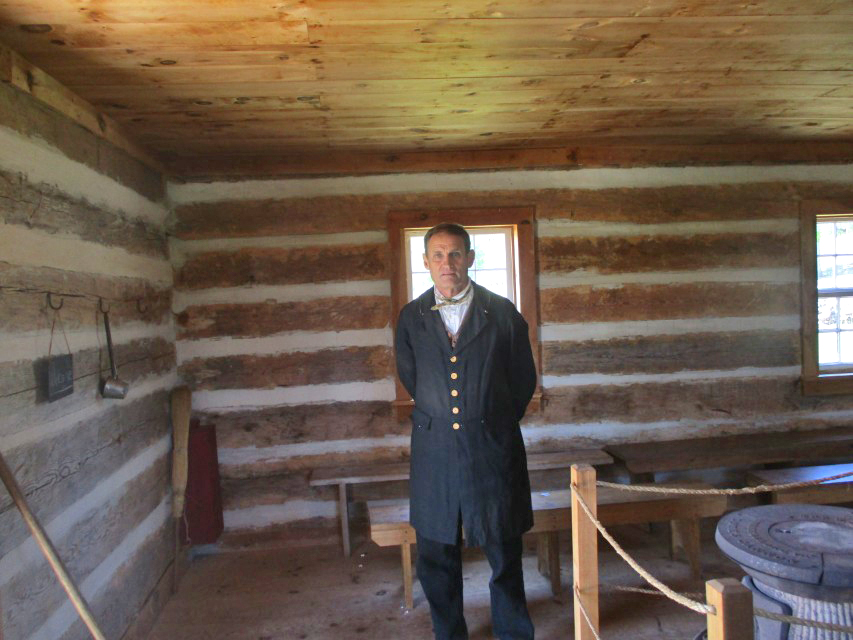
There is a small
schoolhouse from the 1840s transplanted to the museum. I thought
the stern schoolmaster inside was more interesting than the
building itself.
If you are
on Interstates 64 or 81 in Virginia, this museum is certainly
worth a stop. From the intersection of the two interstates, the
driving distance is less than two miles. It's a high-quality
living history experience. Its also a lot of fun.
Author/Photographer. Tom
Straka is an emeritus professor of forestry at Clemson
University in South Carolina. He has an interest in history,
forestry and natural resources, natural history, and the
American West.
Public
Disclosure Please Read FTC has a law
requiring web sites to let their readers know if any of the
stories are 'sponsored' or compensated. We also are to
let readers know if any of our links are ads. Most are not.
They are just a way to direct you to more information
about the article where the link is placed. We have several ads
on our pages. They are clearly marked as ads. I think
readers are smart enough to know an ad when they see one but to
obey the letter of the law, I am putting this statement here to
make sure everyone understands. American Roads and Global
Highways may contain affiliate links or ads. Further, as their
bios show, most of the feature writers are professional travel
writers. As such we are frequently invited on press trips, also
called fam trips. On these trips most of our lodging, dining,
admissions fees and often plane fare are covered by the city or
firm hosting the trip. It is an opportunity to visit places we
might not otherwise be able to visit. However, no one tells us
what to write about those places. All opinions are 100% those
of the author of that feature column.
|