Tracing Freedom's Heritage Trail
Photos and article by Kathleen Walls
 |
It all began with the Westward expansion.
A covered wagon at the National Frontier Trails Museum |
Most people think
of the War Between the States as neatly fitting into the span of years between the firing
on Fort Sumter and Lee's surrender at Appomattox Courthouse. In reality its roots are
far earlier. Fort Sumter may be the first official shots fired but they were certainly not
the first shots fired. If you want to take a history related vacation that traces the
war's beginnings, you need to visit western Missouri and eastern Kansas . This area
had been designated Freedom's Frontier National Historic Area in October 2006. This
is not done lightly. An area must have played an outstanding part in American history.
Freedom's Frontier is rightly held to be the birthplace of the Civil War. While on a recent FAM trip through Freedom's
Frontier, I was able to visit many of the places of historical importance there. There are
still so many other that I would like to visit later.
The brash new state of Missouri
was welcomed into the band of 23 other states in 1821. The slavery issue was already
causing debate in Congress and Missouri was to be the only slave state carved from the Louisiana
Purchase . By the rules of the "Missouri Compromise" Missouri entered as a slave
state and Maine as a free state thus maintaining the balance. That balance was not to hold
for long.
When President Jefferson
purchased the Louisiana Territory in 1803, the stage was set for America 's westward
expansion. Lewis and Clark's famous expedition was the signal for first a trickle
then a torrent of settlers to pull up stakes and move westward. . It is estimated 400,000 people traveled west on
one of the four trails between 1840 and 1860.
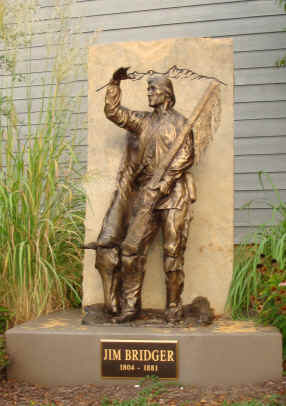 |
| Jim Bridger, one of the mountain men who helped open up the west. |
National
Frontier Trails Museum logically
is the first stop on your personal Freedom's Trails trip. This is the only museum
devoted to the three great western routes: the Santa Fe, Oregon and California Trails. In
addition it includes information on the Mormon Trial as well. Located in Independence, MO , the principal
"jumping off" point for all three trails, the museum tells the story of our
nation's westward expansion with exhibits and quotes from those who drove those
trails so long ago.
Josiah Gregg was one such
traveler who made the trip. He left Independence on the Santa Fe Trail in May 1831 and
later wrote his story as a book called Commerce of the Prairies. He told of the beginning
of the journey.
The new town of Independence, but twelve miles from
the Indian border and two or three south of the Missouri river, being the most eligible
point, soon began to take the lead as a place of debarkation, outfit and departure, which,
in spite of all opposition, it has ever since maintained. It is to this beautiful spot,
already grown up to be a thriving town, that the prairie adventurer, whether in search of
wealth, health or amusement, is latterly in the habit of repairing, about the first of
May, as the caravans usually set out some time during that month. Here they purchase their
provisions for the road, and many of their mules, oxen, and even some of their wagons
— in short, load all their vehicles, and make their final preparations for a long
journey across the prairie wilderness.
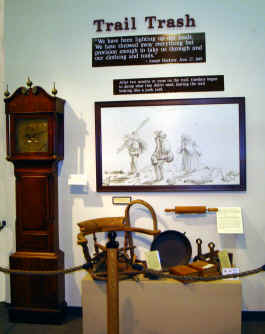 |
| Some of the items abandoned on the trail. |
Once across the
Missouri River, a traveler was in " Indian Territory " but the natives were only
one of the problems they faced. One museum exhibit shows some of the beautiful and
personal items travelers had to discard along the trail in order to save their lives.
Many did not even save
that. The Donner Party is one of the saddest stories told at the Trails Museum .
One writer referred to
the Oregon Trail as the "nation's longest graveyard." Had the dead been
buried evenly spaced along the length of the Oregon Trail, there would be a grave every 50
yards from Independence to Oregon City . During the height of the western trails movements
over 65,000 deaths were recorded.
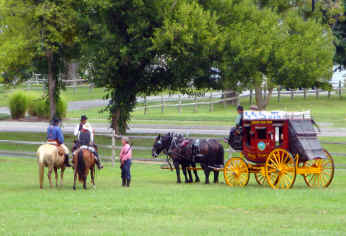 |
| Mahaffie stagecoach |
During the days of
the westward movement, stagecoach stops were of utmost importance. Travelers by coach
could not carry provisions like the settlers taking the slower wagon trains so there
needed to be stopovers where the passengers could eat and spend the night in comfort. Mahaffie Stagecoach Stop and Farm was one such
place. It is the only stagecoach stop open to the public on the Santa Fe Trail . It's
located on Olathe, Kansas . The brand new visitor center offers a museum where we were
abole to get a feel for what it was like in those days for the passengers and J.
B.(Beatty) and Lucinda Mahaffie and their children. The site has three 19th
century buildings and several reconstructions. While there I got to ride in a stagecoach
for the first time and sample some cornbread cooked in a wood stove in the cellar of the
1865 home where Lucinda Mahaffie and her daughters fed the passengers. This home was built
to replace the original 1858 home the Mahaffie's lived in originally. You can also
visit the authentic livestock kept onsite.
 |
| Stature of the Buffalo Soldier at Fort Leavenworth. |
In 1827, Fort Leavenworth
was established by the U.S. government with Col. Henry Leavenworth as commander. It was
positioned on the Missouri River's right bank of Salt Creek to protect the western
frontier and travelers setting out on the Santa Fe Trail .
On my recent trip, I got
to tour the Buffalo Soldier Museum at Fort
Leavenworth. Even thought it is on a military base, you can to as long as you have
valid ID. They have then largest collection of horse drawn wagons in the nation. After the
Civil War, many of the freed slaves became Buffalo Soldiers and served bravely.
In the midst of this
turmoil was another group of people whose lives were drastically changed by this westward
expansion: American Indians. The Haskell Indian
Nations University (HINU) today is an accredited university for Native Americans but
when it first opened in 1884 it was called the United States Indian Industrial Training
School . There children who had been separated from their parents were forcibly
"westernized" their culture stripped away and a veneer of "white
culture" imposed on them. The Cultural Center of the university today is a museum
dedicated to Native American Culture. American Indian Athletic Hall of Fame is also
located on campus. Both are worth a visit.
 |
| The Eldridge Family portrait at the Eldridge Hotel in Lawerence |
Many of the
settlers who came to Kansas Territory during that time were looking for land: a way to
improve their lives. But not all. There were those with political motives. Some of these
people believed that slavery was an evil that must be stopped. Others had less noble
motives. They wanted a place where they could use the political issues as an excuse to
loot and become rich. Some just were lawless and enjoyed robbing and killing for the
thrill. The stage was set for an explosive drama of death and destruction that would begin
before Fort Sumter and not end with Appomattox Courthouse.
 |
| Jim Brothers sculpture dipicting Pheonix rising from the ashes of
the Free-State Hotel. |
In 1854, congress
in effect repealed the Missouri Compromise and replaced it with the Kansas-Nebraska Act
which stated that the settlers of the territories would themselves decide if thy wanted to
be slave or free. Stephen Douglas backed the act saying, "The great principle of self
government is at stake, and surely the people of this country are never going to decide
that the principle upon which our whole republican system rests is vicious and
wrong."
The city of Lawrence in the Kansas Territory was founded in
1854 as a direct response to the Kansas-Nebraska Act
by a group of New England abolitionists to be sure the voters in the Kansas Territory
would be free-state men. They founded the New
England Emigrant Aid Company to bring free-state settlers to Kansas .
Local settlers in Missouri felt Kansas was rightfully
theirs as the nearest free land for their expansion and did not welcome the new settlers.
On December 1, 1855, a posse led by Sheriff Samuel J. Jones burned the Free-State Hotel in
Lawrence and looted two anti-slavery newspapers and several other businesses. This became
known as the Sack of Lawrence. In spite of the destruction, only one man was killed. And
that was caused by a stone falling from the burning hotel rather than a bullet.
 |
 |
| "Widow Doyle" of the Lecopmpton Reenactors. |
"John Brown" of the Lecompton Reenactors |
This desecration is believed to be what triggered
the retaliation by John Brown and
his men known as the Pottawatomie Massacre. During the night of May 24 and the
morning of May 25, 1856, Brown and some free-state militiamen known as the Pottawatomie Rifles, killed five pro-slavery settlers in
Franklin County Kansas. The account of some
of those killings was reported in the "Republican
Citizen," Paola, Kansas , 20 Dec 1879. Below is
the statement of a witness, James Townsley quoted in that paper.
The old man Doyle and two sons were called out and
marched some distance from the house toward Dutch Henry's in the road, where a halt was
made. Old John Brown drew his revolver and shot the old man Doyle in the forehead, and the
two youngest (Brown) sons immediately fell upon the younger Doyles with their short
two-edged swords. One of the young Doyles was stricken down in an instant, but the other
attempted to escape, and was pursued a short distance by his assailant and cut down.
After the massacre, three of Brown's men were taken
prisoner including two of his sons.
 |
| "John Brown" at Black Jack Battlefield. |
On the heels of this came the battle that is considered
by many historians to be the first actual battle of the Civil War. It began at a small
campground called Black Jack Springs Campground because of the black jack oaks that
grew there at the time. It was commonly used by the wagon trains as a stopping point on
the Santa Fe Trail . In fact today, you can see the swales or indents in the ground made by
the hundreds of wagon trains that passed there. But on the night of June 2, 1856, John
Brown and a group of just over 20 men came there searching for Captain Henry Clay Pate,
leader of the pro-slavery militia unit Shannon's Sharpshooters. Pate was one of the
men who had taken part in the Sack of Lawrence. Brown found Pate and somewhere between 30
and 75 men camped at Black Jack.
Brown and Pate's men fought for over five hours and
the battle finally went in favor of Brown. He exchanged Pate and 22 of his men for the
freedom of his sons and the other man taken after the Pottawatomie Massacre. The Federal
commander who arranged the exchange was a brand new West Point graduate named J.E.B.
Stuart. You can visit the site now. The battlefield is located in Robert Hall Pearson Park .
Pearson was a fighter with Brown who later bought that portion of land. His decendants
recently sold the house and land to the Foundation who plans to renovate the house as it
was in the days of Pearson's original occupancy. Kerry Altenbernd did a superb
reenactment of John Brown as he narrated the battle for us.
Of course things degenerated rapidly after that. One
battle followed another sacking and another looting resulted in more killing. There were
far too many to recount in a mere article. Perhaps a book could tell much more. But
that's a project for a later date.
A Kansas territorial government is set up in Lecompton
in 1855 by pro-slave-state people. Here I visited several of the historic sites. The
Territorial Capital Museum was begun as the state capital of Kansas . Here I witnessed
a very moving play that helped clarify the confusing situation that swirled about the Kansas
statehood issue.
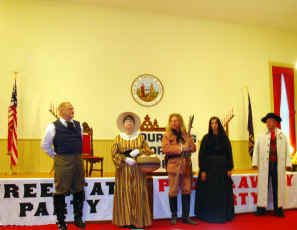 |
| Partial cast of the Lecompton Reenactors at Territorial Capital Museum. |
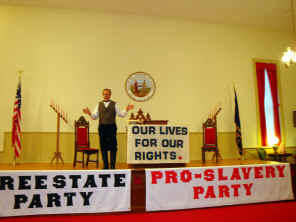
The Lecompton Reenactors relived a hypothetical
night at a Lecompton Town Meeting when legendary characters spoke of their experiences and
beliefs. The play, "Bleeding Kansas," was mostly a series of monologues as each
character expressed his/her beliefs in what kind of state Kansas should become. The
audience seated in either the "free-state section" or the "pro-slavery
section" was part of the performance as they were expected to cheer or boo as the
views were expressed. The performers represented people of the era on both sides of the fence. "Clarina Nichols," a Kansas newspaper
woman, expressed a need for abolition of slavery, women's suffrage and total
annihilation of that "demon, alcohol."
 |
| "Jim Lane" of the Lecompton Reenactors. |
"Jim Lane," an opportunistic free-state
politician, who would go on to become a U.S. Senator and later a suicide, eloquently spoke
of Kansas future as a free state . The show as stolen by "Mahala Doyle," widowed
and robbed of two sons at John Brown's Pottawatomie Massacre. Her widow's
clothing an effective prop for her eloquent recital of her hatred of John Brown and his
actions on the night he took her husband and two sons from their humble home and brutally
slaughtered them. Myself, along with the rest of the stunned audience, was incapable of
cheering or booing. We sat near tears as she left the stage and met "John Brown"
himself as he took his place to speak. He raised his gun and one of the Bowie knives he
would later have fastened to hundreds of pikes to arm a slave rebellion. He railed about
the evils of slavery and the drastic measures necessary to eradicate such an evil.
Ironically, I found this in a biography of John brown related to the Doyles:
John Brown, A
Biography by O. G. Villard
Three and one half years later, when
in jail and under sentence of death, John Brown
received the following letter purporting to come from Mahala Doyle. Mrs. Doyle could
not write, and the letter is obviously, in its style, beyond her homely powers of
expression, though she may have signed it, and there is nothing in it she might not have
said in her
own way:
CHATTANOOGA, TENNESSEE Nov. aoth, 1859.*
JOHN BROWN: — SIR, — Altho' vengence is not mine I confess
that I do feel gratified, to hear that you were stopped in your fiendish
career at Harper's Ferry, with the loss of your two sons, you
can now appreciate my distress in Kansas, when you then & there
entered my house at midnight and arrested my Husband and two
boys, and took them out of the yard and in cold blood shot them
dead in my hearing, you cant say you done it to free slaves, we had
none and never expected to own one, but has only made me a poor
disconsolate widow with helpless children, while I feel for your
folly I do hope & trust that you will meet your just reward. O how
it pained my heart to hear the dying groans of my Husband & children,
if this scrawl gives you any consolation you are welcome to it
MAHALA DOYLE. N. B.
My son John Doyle whose life I beged of you is now grown
up and is very desirous to be at Charlestown on the day of your
execution, would certainly be there if his means would permit it
that he might adjust the rope around your neck if Gov. Wise would
permit it. M. DOYLE.
When it became apparent that Lecompton would not be the
capital, the building later became Lane University . A pro-slavery institution being named
for an ardent foe like Jim Lane was just another of those confusing circumstances that
riddled "Bleeding Kansas" at this time. The Institute, as part of its fund
raising, offered to name the university for the person who pledged the most money to
complete the construction. Jim Land pledged $1000 and earned that honor. He felt it was
the worst insult he could offer the college. Although Lane never actually paid the money,
the college honored its promise. In later years it would become President
Eisenhower's father and mother's Alma-Mata and the scene of their first meeting.
 |
| Constitution Hall In Lecompton. |
I then visited Constitution Hall where
pro-slavery elements met in Lecompton to draw up what is later called the "Lecompton
Constitution." This document would have made Kansas a slave state but was narrowly
rejected by Congress in 1857. Meantime, a free-state territorial government is also set up
in Topeka at about the same time. They elect Charles Robinson governor. Neither side
recognizes the other government.
Eventually, the government set up in Wyandotte, now part
of Kansas City, submitted the accepted constitution in July of 1859 allowing Kansas to be
admitted to the Union as the 34th state in 1861. The country was headed towards
disintegration rapidly. The Democrats split over the issue and fielded two candidates John
C. Breckenridge and Stephen A. Douglas. This split allowed Abraham Lincoln, the nominee of
the newly minted Republican Party, to win the presidency in 1860. Now the rest of the
nation would be drawn into the fight that had been raging along the Kansas- Missouri
border for so long.
 |
| Cass county Mural represinting the raid on H.W Younger store. |
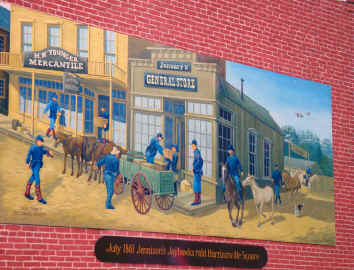
The Cass County Historical Society recently dedicated
the two outdoor murals depicting turning points in the history of Harrisonville, Missouri:
"July 1861 -- Jennison's Kansas Jayhawks Raid the Harrisonville Square" and
"Order Number 11" by artist Dan Brewer. They represent some of the next events
to unfold in the struggle. Shortly after the war, old news here, was officially declared,
a group of Federal militia, the Seventh Kansas Cavalry Regiment, led by Charles Ransford
Jennison attacked and looted the town of Harrisonville, Missouri . He particularly
concentrated on the livery and store owned by one Henry Washington Younger. At this time,
Mr. Younger was the mayor to the town as well as a respected businessman who held the
postal contract with the federal government. Younger's eldest living son, Thomas
Coleman, later fought with one of Jernnison's officers at a party over his
sister's refusal to dance with any man who had harassed her father led to the young
man having to flee the county in fear of his life.
 |
Carol Bohl AKA Bersheba Younger shows the Quantrill cutout at the Cass
County Historical Museum, |
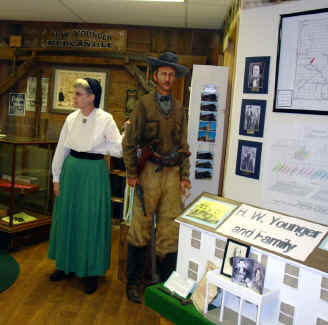
The disgruntled
officer later killed the senior Mr. Younger as he returned from a business trip. The grief
stricken son banded with a known guerilla fighter who defended the pro-slavers, William
Clarke Quantrill. Quantrill and his men swooped into Lawrence with about 400 fighters and
killed aver 180 men and boys. Jennison and Lane, specific targets of the raid escaped. The
raid went down in history as the Lawrence Massacre and earned Quantrill the reputation as
the bloodiest fighter in the border war. Younger's son went on to a infamy of his
own, today he is remembered as Cole Younger.
I had an opportunity to visit both Lawrence and the
Eldridge Hotel. It is a fascinating town that has lived up to the motto born in the
destruction of those turbulent days, "From
Ashes to Immortality." A imaginative sculpture by Jim Brothers of Phoenix rising from
the ashes. The building from which he is rising is the Free State / Eldridge Hotel stands
in the plaza of the Lawrence Visitor Center .
 |
| "Bersheba Younger" prepares to torch her home under orders of Union
militia. |
The city has truly lived up to its motto. Its main
street, Massachusetts Ave. is considered one of the prettiest main streets in the country. Today, it's a vibrant college town, home of Kansas
University . There are still many reminders of its bloody past from the name of the
university mascot, the Jayhawker, to its old Oak Hill Cemetery, final resting place
of people like Jim Lane, Solon O. Thacher, Chair of the Wyandotte Constitutional
Convention, and many others killed in the Quantrill raids well as Quantrill's Raid Monument .
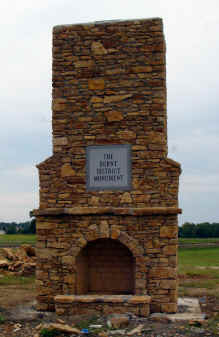 |
| The Burnt District Monument |
The Lawrence
Massacre is believed to have inspired the infamous Order Number 11. This order signed by
Brigadier General Ewing directing the federal militia to remove all citizens of three
complete and a portion of a fourth county in Missouri who had not taken the pledge to of
loyalty the federal government. (Remember, Missouri
was not one of the Confederate States: not an enemy country but a part of the U.S. )
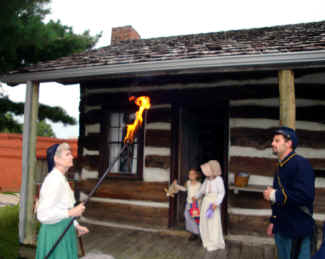
The Cass County Historical Society invited us to a
play produced by them on the porch of the county's oldest home, the Sharp-Hopper Cabin. This cabin was built in 1835
and was one of the few structures left standing after the implementation of Order Number
11. The play is one I would advise you to see if possible. It portrays the removal of
Bersheba and her family from her cabin which she then was forced to burn down. The society
also had a nice museum depicting life up to the time of Order Number 11. I was impressed
by the lifesize, historically accurate cutouts of Quantrill and Cole Younger. The Burnt District
Monument is a brand new memorial to those trying times. I felt privileged to be among the
first group of journalisrts to visit it.
As the war rages across
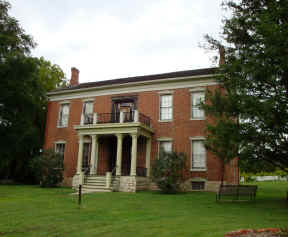
the county, Kansas and Missouri were in the middle of it. One memorable battle, the Battle of Lexington, occurred at a home owned by Oliver Anderson. It was originally
built by Anderson when he relocated from Kentucky to Lexington, Missouri in 1851. It is a
beautiful example of how well-to-do slaveholding families lived in Missouri in that period
and has been called "The largest and best arranged dwelling house west of St. Louis "
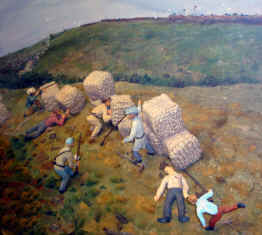
but it is better known as the house that changed hands three times in the course of the
fierce battle fought there in September 1961. The house began as a Union hospital, was
taken by the Confederates under Major General Sterling Price, recouped by the Union under
Colonel James A. Mulligan and retaken by Price's Confederates. The loss of lives in
the three day battle was 25 confederates and 39 Union . You can see bullet holes and a
cannon ball still lodged in the old home. Is it any wonder that there are rumors of
restless ghosts within its walls?
 |
 |
| A front view of the Anderson House. |
Diarama of the Battle of Lexington in Visitor Center for Anderson House. |
I would recommend
anyone who has an interest in our country's history visit Freedom's
Frontier's National area. While you travel this entire blood stained stretch of
Kansas Missouri borderland it is easy to imagine many who died on both sides of this, our
nation's worst bloodletting, crying our across the void between life and death
"How did this happen? Why did I die?"
There are so many sites
that I know I don't have all listed here but I tried to get most of them.
Has links for many Freedom's Frontier sites: http://moksbwn.net/MembersDetail.htm#M11
Mahaffie Stagecoach Stop and Farm: http://www.kansastravel.org/mahaffiestagecoachstop.htm
Oak Hill Cemetery : http://www.kansastravel.org/oakhillcemetery/index.htm
Buffalo Soldier
National Museum : http://garrison.leavenworth.army.mil/sites/about/Buffalo.asp
Black Jack Battlefield Trust: http://www.blackjackbattlefield.org/
Lawrence
CVB: http://www.visitlawrence.com/
Lecompton: http://www.lecomptonkansas.com/
Trails Museum : http://www.ci.independence.mo.us/NFTM/
Cass County Historical Society: http://www.casscountyhistoricalsociety.org/
The Haskell Indian Nations
University Museum :
http://www.visitkc.com/member-details/index.aspx?id=34839
|